
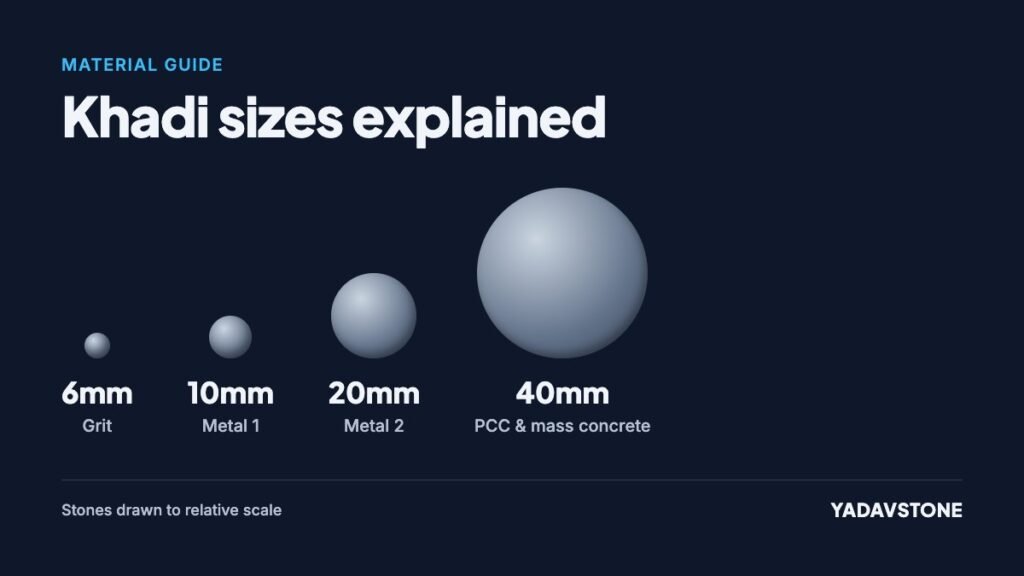
Khadi (crushed stone aggregate) is sold in four main sizes on Mumbai sites: 6mm (grit), 10mm (metal 1), 20mm (metal 2) and 40mm. For most RCC work – slabs, beams, columns and footings – 20mm is the standard size; 10mm goes into thin or congested sections, 40mm into plain and mass concrete, and 6mm grit into rough-cast plaster finishes.
The size is the stone’s nominal size: roughly the sieve that most of the load passes. Below is each size with what it is used for, the Indian Standard behind it, and how to pick the right one for your job.
Khadi sizes at a glance
| Size | Also called | What the standard says | Typical use |
|---|---|---|---|
| 6mm | Grit | Trade size; IS 383 coarse aggregate starts at 10 mm | Rough-cast plaster finishes, very thin precast work |
| 10mm | Metal 1, 10mm crushed stone | IS 383 single-size 10 mm | Thin sections, closely spaced bars, precast; blended with 20mm |
| 20mm | Metal 2 | IS 383 single-size or graded 20 mm; IS 456: suits most work | Slabs, beams, columns, footings |
| 30mm | – | Trade size; no IS 383 nominal size | Only when your drawing calls for it |
| 40mm | – | IS 383 single-size or graded 40 mm | PCC, mass concrete, floor base concrete |
Khadi is the coarse aggregate: stone retained on the 4.75 mm sieve. The fine aggregate that goes with it is crushed sand (0–4.75 mm), also called khadi sand or crush sand on site. Kapchi (40/60mm broken stone) is a separate product for soling and base work, not a concrete size.
How to choose the right khadi size
The concrete code, IS 456:2000, sets the rules for the largest stone size in a mix (clause 5.3.3):
- 20 mm suits most work. That is why 20mm (metal 2) is the everyday RCC size.
- No bigger than a quarter of the thinnest part of the member you are casting.
- Close bars or small cover: for heavily reinforced members the size is usually 5 mm less than the minimum clear gap between main bars or the minimum cover, whichever is smaller (cl. 5.3.3.1). This is where 10mm (metal 1) comes in.
- 40 mm where concrete flows freely – plain and mass concrete such as PCC and floor base concrete (IS 2571 covers flooring).
- 6mm grit is for finishes, not structural concrete. IS 2402 refers to crushed stone of about 6–12 mm for rough-cast rendering.
Your engineer decides. The structural drawing or mix design always overrides a rule of thumb. If it names a size and says single-size or graded, order exactly that.
Single-size or graded khadi?
IS 383:2016 lists coarse aggregate in two forms, and the difference matters when you order:
- Single-size – mostly one size. Single-size 10 mm, for example, has 85–100% passing the 10 mm sieve and no more than 20% passing 4.75 mm.
- Graded – a mix of sizes in one load. Graded 20 mm has 90–100% passing 20 mm and 25–55% passing 10 mm, so it is effectively 10mm and 20mm together.
- There is no graded 10 mm in IS 383; graded sizes start at 12.5 mm.
Saying only “20mm” on the phone leaves the grading open. Tell us whether your mix design asks for single-size or graded, and in what proportion it blends 10mm and 20mm.
How much khadi do you need?
- 1 brass = 100 cu ft ≈ 2.83 m³. A brass of khadi weighs roughly 4.5–5.4 tonnes, depending on the stone and how wet it is (approximate, from IS 875 unit weights). For an exact weight, ask for the weighbridge slip.
- Example (M20 nominal mix): IS 456 Table 9 allows at most 250 kg of total aggregate per 50 kg bag of cement. At 1:2 sand to khadi, 100 bags use at most 25 tonnes of aggregate: about 8.3 t of sand (≈ 1.9 brass) and 16.7 t of 20mm khadi (≈ 3.1–3.7 brass). Design mixes differ, so follow your engineer’s quantity sheet.
- To check a load: truck body length × width × height in feet ÷ 100 = brass.
What to check when khadi arrives
- Size: pick up a handful. Most pieces should match the size you ordered, with no stray oversize chips or soil lumps.
- Flaky pieces: flaky means thinner than about 0.6× the piece’s size; elongated means longer than about 1.8×. IS 383 caps the two together at 40%, so a handful shouldn’t be mostly flat slivers.
- Contamination: no soil, roots, coal bits, mica flakes or shells – IS 383 lists these as harmful.
- Quantity: measure the truck body or check the weighbridge slip on tonne orders.
How YadavStone can help
All our khadi is VSI-crushed and we supply every size – 6mm grit, 10mm, 20mm, 30mm and 40mm – plus crushed and washed sand. We work 24/7, with same-day delivery available across Mumbai, Navi Mumbai and Panvel. The minimum order is 6 brass (or 25 tonnes), with a GST invoice on every load. Rates are indicatively ₹3,000–₹6,000 per brass across our materials (October 2026), depending on distance, quality and type of material.
Call +91 86918 59278 or WhatsApp us with the size, quantity and site location for today’s delivered rate. Not sure which size you need? See our khadi size guide and supply page.
Frequently asked questions about khadi sizes
Usually 20mm (metal 2), because IS 456 says 20 mm aggregate suits most work. It is often blended with 10mm (metal 1) where the slab is thin or the bars are close together. Your engineer’s drawing or mix design decides.
Yes. On Mumbai sites 6mm khadi is called grit. It is a trade size, not a nominal size in IS 383, so if your drawing says 10 mm single-size, order 10mm khadi instead.
They are local names for khadi sizes: metal 1 is 10mm khadi and metal 2 is 20mm khadi. 6mm khadi is called grit.
No. 40mm khadi is screened coarse aggregate for concrete, to the IS 383 40 mm grading. Kapchi is broken stone for soling, filling and base layers.
Sources: IS 383:2016 (coarse and fine aggregate for concrete) · IS 456:2000 (plain and reinforced concrete, cl. 5.3.3 and Table 9) · IS 2402:1963 (external rendered finishes) · IS 2571:1970 (cement concrete flooring) · IS 875 (Part 1) unit weights. The standards describe what to ask for; they are not test results for a particular load.